Concern Summary: UNESCO presents itself as a global force for education, culture, and ethical cooperation, yet its influence extends into shaping worldview frameworks that affect how societies understand truth, identity, morality, and human purpose. When educational standards, cultural narratives, and ethical principles are increasingly defined through human consensus detached from divine authority, there is a risk that humanity’s understanding of reality becomes progressively reoriented away from the Creator and toward institutional frameworks. The concern is not education or cooperation themselves, but the concentration of influence over foundational human formation at a global scale. Scripture warns that wisdom separated from God…

Concern Summary: The modern cultural shift toward subjective truth and consensus-driven morality increasingly reframes conviction as intolerance and clarity as confrontation. As objective truth becomes marginalized, individuals who stand firmly in biblical truth may experience social, professional, and relational pressure to compromise or remain silent. This environment fosters confusion, discourages moral courage, and subtly conditions society to reject divine authority in favor of human perception. Scripture Insight: Scripture consistently reveals that truth has never been universally accepted, because truth exposes both sin and misplaced authority. When individuals align themselves with God’s Word, they often encounter resistance not merely from people,…

Concern Summary: Modern society is increasingly shaped by narratives, systems, and technologies that influence perception rather than illuminate truth. Media ecosystems, algorithmic amplification, institutional messaging, and emerging artificial intelligence technologies create environments where constructed realities can feel more convincing than objective reality itself. As individuals become surrounded by competing interpretations of events, confusion grows, trust declines, and certainty becomes fragile. This manufactured perception does not only affect politics or culture; it reaches into identity, morality, and spiritual understanding. When truth becomes negotiable, individuals lose the ability to anchor themselves in stable foundations. Scripture warns repeatedly that deception increases in the…
Scripture Insight Jesus reveals that true life is not sustained by consumption, systems, or self-preservation, but by submission to God’s spoken truth. The enemy’s temptation was not merely about hunger, but about authority—whether man would act apart from God’s Word even to meet legitimate needs. Where Scripture governs, life flourishes even in scarcity; where it is rejected, decay sets in even amid abundance. Echo Man survives by what he consumes. He lives by what he obeys. When God’s Word is exchanged for comfort, control, or convenience, the body may be fed—yet the soul begins to starve. Reflection This…

Concern Summary: Halloween has been paraded as harmless entertainment—a night of fantasy, laughter, and community. Yet beneath the costumes and candy lies a powerful deception: the celebration of darkness disguised as fun. Its roots reach back to Samhain, the pagan festival honoring the spirits of the dead, where fear was used as a shield and ritual offerings invited spiritual forces into human affairs. Today, that same ritual has been repackaged by Hollywood and the global entertainment industry, conditioning hearts to delight in what God detests. The symbols of death, witchcraft, and fear—once shunned as evil—are now glorified as art and…
Intro Overview Christ overturned the world’s definition of greatness. Where men seek power, He revealed humility; where leaders crave recognition, He modeled service. In washing His disciples’ feet, He showed that true authority is not domination but devotion — not ruling over others, but lifting them up. His life was the ultimate demonstration that leadership in the Kingdom begins with surrender. Devotional Overview The measure of a leader is not found in influence or applause, but in quiet obedience to God. Christ’s example reminds us that leadership divorced from servanthood is hollow. To lead like Jesus is to carry a…

We live in an age obsessed with validation. Social platforms reward visibility, companies reward image over integrity, and even churches can sometimes prize popularity above holiness. But this isn’t new—Jesus rebuked the Pharisees for the very same thing: “For they loved the praise of men more than the praise of God” (John 12:43). Paul warned that in the last days people would become “lovers of their own selves” (2 Timothy 3:1–2), a culture driven by pride and self-worship. And Romans 1:25 reminds us that when mankind rejects God’s truth, it inevitably replaces it with idolatry—worshiping the creature rather than the…
The crises we see today—political upheaval, economic collapse, cultural confusion—are not the root but the fruit. At the heart of them all lies a deeper issue: leaders who refuse to fear God. Across parliaments, corporations, and even religious institutions, leadership has been stripped of accountability to divine authority. Titles abound, but wisdom is scarce. Scripture tells us that the fear of the Lord is the beginning of wisdom. Without it, leaders govern by power, influence, and image rather than truth and justice. They bend morality to suit agendas, normalize corruption, and call evil good and good evil. Romans 3:18 describes…

At the summit of power, laws are not always written for justice—they are written for self-preservation. What the world calls “progress” or “rights” is often a carefully crafted legal cover for immorality. When sin is legalized, it spreads like a contagion, normalizing perversion while silencing righteousness. This is not merely cultural decay; it is a calculated spiritual rebellion to invert God’s order and call evil good. Scripture warns of such times. Isaiah declared “Woe unto them that call evil good,” and Romans 1 reveals the downward spiral of societies that exchange God’s truth for lies. This is precisely what we…
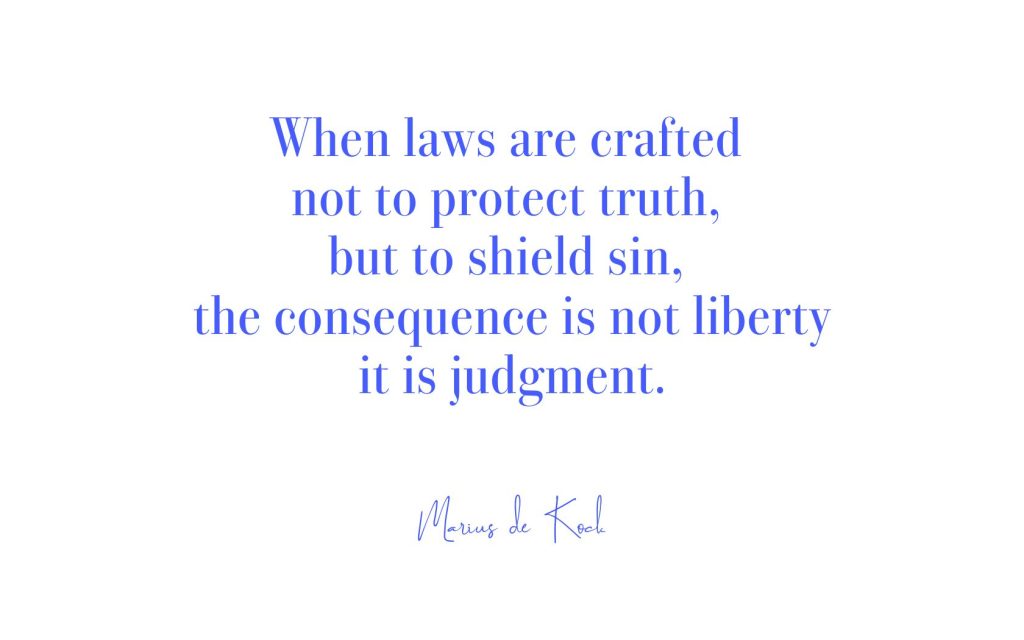
In every generation, law reveals the moral compass of a nation. When laws are rooted in righteousness, they preserve life, restrain evil, and reflect the justice of God. But when laws are twisted to normalize sin, protect corruption, and silence truth, they become instruments of rebellion. We see this across the world today—where perversion is legalized, immorality is celebrated, and righteousness is criminalized. These are not signs of liberty, but markers of a society under judgment. Scripture reminds us that God’s wrath is revealed against all unrighteousness. Nations that embrace wickedness do not escape consequence; instead, their rebellion invites His…